
- We refer to our bottles as ‘eco-flat’, ‘eco bottles’, or ‘flat, 100% recycled PET (rPET)’.
- We avoid referring to our bottles as ‘plastic’ bottles. ‘Plastics’ is a collective noun for a group of polymers, all with individual properties and characteristics. The most common types of plastics used in packaging are separated into Resin Identification Codes:
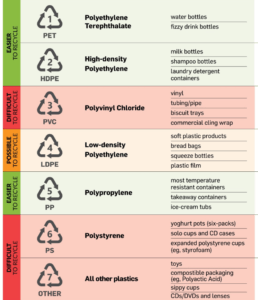
- PET is widely recycled – it is collected by 99% of UK local authorities in kerbside recycling (Recycle Now).
- We also prefer to preface the word PET to be even more specific – using the name “recycled PET” (rPET), which makes it clear that the material is 100% recycled content.
- By referring to the specific material instead of an unhelpful and generic term like ‘plastic’, we start to disassociate the ‘good’ plastics from the ‘bad’ plastics to help champion the use of wonder materials like rPET.
- 100% recycled PET is not bad for the planet when compared to glass; here are some of the reasons:
- ‘Plastics’ is an overly simplified term for a complex group of polymers. Calling such a diverse range of polymers, with very different characteristics and behaviours, just ‘plastics’ is like attempting.
- Some of the polymers should be banned outright for specific short life or non-life saving uses (like packaging) as they cannot be recycled (or easily recycled). For example, we would argue that plastics such as polystyrene should be banned from packaging. Conversely, a couple of the polymers, including PET, should be embraced and used responsibly as they can be easily recycled.
- Replacing plastics with an alternative material, such as glass, increases greenhouse gas emissions in most cases, mainly due to the weight savings and energy savings in production that plastics offer (University of Sheffield).
- Our bottles are made from 100% recycled PET and, are widely and easily recyclable after use.
- Being plastic-smart is the best way to help clear up potential pollution, creating a value and demand for material already in circulation to contribute to circular economies. This will put pre-existing PET back to good use and limit the need for new, virgin PET to be produced.
- All these reasons together mean that 100% recycled PET is a climate responsible choice of material, especially compared to glass.
- Glass bottles are in fact the single largest contributor to a wine’s carbon footprint because of the associated weight in transport and the energy required to produce, move, and recycle them:
- In Australia, glass packaging and transport accounted for up to 74% of emissions for wine production (AWRI).
- Glass bottle manufacturing and disposal form 31% of wine’s carbon footprint, with a further 21% directly from transportation (The Wine Society).
- A study by the University of South Australia and the University of Adelaide found alternative packaging options such as flat PET bottles and ‘bag-in-box’ are up to 51% more carbon-efficient.
- The high carbon footprint of glass wine bottles is due to glass production being highly energy-intensive due to the need for a furnace to melt the raw material:
- Glass is required to be melted at extremely high temperatures of up to 1600°C (Science Direct).
- A glass furnace can use up to 191,000 kWh of energy per day – which could supply the average UK household for 12 years (BCC).
- Also, a glass furnace runs 24/7 at this temperature – it cannot be stopped or cooled during its 15-18 year lifetime (AGC Glass Europe).
- Additionally, glass mining can lead to significant environmental damage and loss of biodiversity (BBC).
- In addition, research on beverage packaging revealed that a virgin (new) PET bottle has a lower impact on climate change and global warming potential than a glass bottle, even when the glass contains 100% recycled content (Detritus):
- The substantial energy consumption required for glass production is the primary reason PET bottles account for only 37% of the total emissions compared to glass bottles in a study focused on soft drinks (ACS).
- Additionally, recycled PET surpasses virgin PET: in Australia and New Zealand, rPET has, on average, (LCA of Beverage and Food Packaging in Australia and New Zealand).
- For a product like wine, which often travels vast distances across the world, savings made to carbon emissions by targeting this carbon footprint hotspot with lighter and more energy-efficient packaging, is significant.
- Thanks to the use of rPET, a lightweight material, our bottle , reducing transport-related CO2, whilst also bringing emission and energy savings in production relative to glass and virgin PET.
- Additionally, we unlock significant packing efficiency enabled through our flat design that would not be possible with glass:
- In Australia, we fit 96 dozen filled bottles on a pallet, which massively improves on the 48-56 dozen on a pallet for glass bottles (AWRI).
- In the UK, we achieve 100 dozen filled bottles on a pallet, which resulted in 30% less lorries on the road due to our special efficiency in a study with Aldi UK following our launch with them in 2024.
- The CO2 savings achieved by switching from glass bottles to recycled PET bottles cannot be equalled by merely reducing the weight of a glass bottle:
- A 2023 LCA by AWRI concluded a 330g lightweight glass bottle to have 885 g CO2e of emissions. Packamama bottles still offers more than a 30% reduction in emissions relative to lightweight glass bottles (AWRI).
- According to data from an LCA performed on behalf of the leading Nordic alcohol companies, switching lighter glass bottles to PET reduces CO2 by 54%. (Systembaloget).
- Glass also brings risk of breakage during transport, and with thinner glass used in lighter weight bottles, there is increased likelihood of cracking and defects occurring during cooling, requiring re-manufacture of the bottle at high-energy expense (Rabobank).
- rPET is not brittle: it is more robust and shatterproof compared to glass, ensuring more secure transportation.
- Determining the exact number of times a PET bottle has been recycled is not feasible as of now because PET material is shredded down into “flake” and pelletised during the recycling process. Each batch of recycled PET flake contains materials of varying ages and recycling cycles. The critical factor is the overall quality of the flake, which dictates its potential for reuse.
- The implementation of deposit refund schemes which will improve PET sorting, and in turn will enhance the purity and quality of the recycled flake. This improvement can lead to an increased number of recycling cycles for the material.
- Additionally, new sorting and mechanical recycling technologies are being developed continuously to recycle bottles more efficiently into PET flake. These advancements contribute to a more effective recycling process.
- Furthermore, advanced recycling mechanisms, such as chemical and enzymatic recycling, are being developed to depolymerize PET back into its original chemical building blocks. These revolutionary technologies enable recycled PET to maintain a quality grade comparable to virgin PET, ensuring high-quality recycling outcomes.
- Primary microplastics are formed during use or manufacturing of a product. There are an estimated 3 million tonnes of primary microplastics globally, from sources such as tyre abrasion (47%), city dust (22%), road markings (20%) and textiles (8%), and not packaging (ETC).
- Secondary microplastics are formed from mismanaged waste, where packaging is unfortunately littered into the environment. With increased awareness and better technology, recycling rates are improving to negate this:
- In Europe, the recycling rate for PET beverage bottles increased to 75% in 2022, compared to 61% in 2020. This upward trend is anticipated to continue as deposit-return systems become more widely implemented across Europe (UNESDA).
- For example, in Sweden, where a deposit-return scheme (DRS) has worked well, 99% of PET bottles were collected for recycling in 2023 (Investigate Europe).
- Packamama partners with material providers and retailers adhering to strict end-of-life policies. Collaborations, such as with Prevented Ocean Plastic, reclaim and recycle plastic near coastlines for bottle production. This actively deters the formation of microplastics in the environment and, along with our other sources of recycled content, ensures a circulation of material.
- Packamama ensures that all product materials are food-contact approved. Products undergo rigorous migration testing to ensure no chemicals leach into the wine. This guarantees consumer safety and minimises the ecological impact from secondary microplastics.
- Additionally, our bottles are fully, easily and widely recyclable to take responsibility out of consumer hands and keeping valuable material in circulation – removing possibility of mismanagement of plastics.
- Our flat, rPET bottle has been designed to remain stable and to withstand a 5.5 degree tilt angle when empty, the same angle as the Leaning Tower of Pisa (prior to remedial restructure work completed in the early 2000s). An increased stability is seen when the bottle is full, with a 6.7 degree tilt angle in this case. This means that when it is full, knocking or bumping into the table will not topple the bottle.
- Firstly, focusing exclusively on the angle of recyclability only addresses the end of life of the product. The energy and emissions generated in producing and moving the material throughout its life also need to be taken into consideration, for reasons stated above. We ensure that our bottle has minimum environmental impact across its entire lifecycle.
- With specific regard to recycling, PET is one of the world’s most recycled and recyclable materials:
- PET is the most commonly collected plastic in the world (World Economic Forum).
- In the EU, 75% of PET beverage containers were recovered for recycling, compared to 74% for glass (BBC) (UNESDA).
- Deposit Return Schemes (DRS) can increase these rates to over 90% in countries where they are in use, for instance, there is over 95% PET beverage container recovery rate in Norway (Institute of Economic Affairs).
- Recycling rates through Container Deposit Schemes (CDS) across Australia are above 50% compared to less than 15% through kerbside recycling (Coca Cola).
- New recycling technologies are being developed to enable depolymerisation which will allow PET to be endlessly recycled:
- Chemical recycling breaks plastic polymers down into their original chemical building blocks, an oil-like liquid, which can then be repurposed into new products.
- Enzymatic recycling breaks down PET into virgin-quality PET using a bacterial enzyme to depolymerise PET back into its original chemical building blocks, which can then be repurposed into new products (Circular Online). As an example, Carbios has been developing enzymatic recycling and first recycled a PET bottle using this process back in 2019. Research is also taking place at the Centre for Enzyme Innovation at Portsmouth University.
- The argument that glass is infinitely recyclable is misleading. While in theory this may be the case, the realities of the real world are different:
- For quality reasons, new wine bottles can’t be completely made out of recycled glass. Flint (colourless) glass can only use up to 60% recycled content because of contamination issues affecting quality (BBC). Our colourless bottle on the hand uses 100% recycled PET.
- Bisphenol-A (commonly known as BPA) and phthalates occur primarily in a different type of plastic called polycarbonates, not in PET, from which our bottles are made. BPA is included as a metric in EFSA (European Food Safety Association) food contact material qualification. All our products fall in line with this qualification and so are safe from BPAs.
- Our recycled PET bottles are fully, easily, and widely recyclable – it is collected by 99% of UK local authorities in curbside recycling (Recycle Now).
- We use a polypropylene (PP) screwcap, which can also be recycled, to avoid mixed material contamination in the recycling stream and make it easier for consumers to recycle the bottle without having to dismantle the packaging.
- We have consulted with RECOUP on this matter and, in contrast, an aluminium closure would have a negative impact on PET recycling streams. The aluminium may damage equipment and also the aluminium would not be recycled.
- We have conducted and passed tests to ensure that our bottles are recognised in UK recycling streams and Nordic Deposit Return Schemes (DRS).
- In Australia, our bottles are part of certain state’s container deposit schemes to ensure material stays in circulation. Our wine bottles were the first wine bottle to be a part of such scheme.
- We are constantly consulting with advisory and regulatory organisations to know if our product can be improved in any way.
- We believe PET, or any other material, should never end up in the ocean.
- PET as a material is not the problem; it is the mismanagement or littering of materials that leads to pollution.
- The argument that we should not use PET because the recycling infrastructure is not perfect, is like saying we should not use electric vehicles because there are not enough charging points. The solution is to improve the infrastructure, not to stop using a viable option.
- 79% of UK consumers recycle 75% or more of their plastic waste (Circular News) and 89% of consumers recycle regularly (Wrap); these are increasingly positive habits that are commanding improvements in infrastructure.
- As our bottles are made from recycled PET, we are taking pre-existing material and giving it another life, closing the loop and contributing to the circular economy.
- We offer the possibility to make our bottles from Prevented Ocean Plastic, which is PET which has been recovered within a 50km distance of an ocean coastline or a major waterway that feeds into the ocean. The country or region from which it is sourced will have a lack of or even no waste management infrastructure or collection services. Prevented Ocean Plastic therefore not only helps intercept material that would otherwise have risked ending up in our oceans, but it also allows this PET material to be recycled, alongside providing employment opportunities for low-income countries through local collection services.
- PET is a very stable, inert material commonly used for food and beverage packaging that does not react with food or beverages. Our bottles do not ‘leach’, which is evidenced by migration testing, and the material is also food-grade approved by authorities and regulatory bodies.
- PET offers only a moderate barrier to oxygen which means a certain level of oxygen ingress occurs; to help mitigate this, we use an advanced, proprietary, active oxygen scavenger technology to create a special barrier and extend the shelf-life of our bottle.
- This barrier has no impact on recyclability of the bottle and is suitable for recycled PET applications.
- In short, it is this barrier technology which enables our bottles to offer a 19 – 21 month shelf life.
- This meets the mass wine consumer market; in the US, for instance, 90% consume a bottle of wine within two weeks of purchase (Wine Business).
- Glass has a place for premium wines that need lying down and ageing. However, for commercial wines that are drunk a short time after purchase, the emissions associated with glass are not justified.
- Consumers is a very broad term as every individual has various purchasing preferences and motivations; therefore, it is important to consider that ‘consumers’ can’t be generalised as one overarching group.
- We believe our bottle is the most premium low carbon alternative to round, glass bottles available. This is because our bottles are still a bottle format which are inspired by the traditional shapes consumers know and love, and they retain the same amount of wine as a traditional glass bottle (75cl).
- As consumers in general become more concerned about the climate crisis and environmental impact, they will seek out more climate-friendly packaging, as manifested in a trend towards including carbon labelling on packaging (Forbes).
- Our bottles help reduce carbon emissions, which is an impactful way of tackling climate crisis, and this aligns with consumer demands as “80% of consumers are concerned about climate change” (Ofgem).
- We also believe there will be many consumers who purchase the product for the convenience and uniqueness of the packaging alone, with little concern for the environmental benefits.
- Our bottles are space efficient, meaning they can be easily transported in backpacks, the back-pocket of trousers, and save space in your fridge.
- Additionally, the unique shape is eye-catching and attracts consumer attention on shelf – it is two centimetres taller than the average glass wine bottle and the flat panelling offers an eye-catching billboard that jumps out on the shelf.
- Our bottles have received positive responses from consumers:
- Analysis of the reviews for our bottles used for Banrock Station in Tesco showed 82% positive sentiment(9% neutral and just 9% negative). Of the 5 negative reviews received, two were concerned about stability, which is addressed above, and three were against the idea of wine moving out of glass. There were no negative reviews from a PET bottle perspective.
- The collection of positive sentiment specific to Banrock Station can be found here.