
Packamama has been recognised as a winner of the prestigious National Energy Globe Award United Kingdom 2022, published in cooperation with United Nations Industrial Development Organization (UNIDO), a worldwide accolade that celebrates and gives visibility to those committed to developing innovative solutions for the most pressing environmental problems of our time.
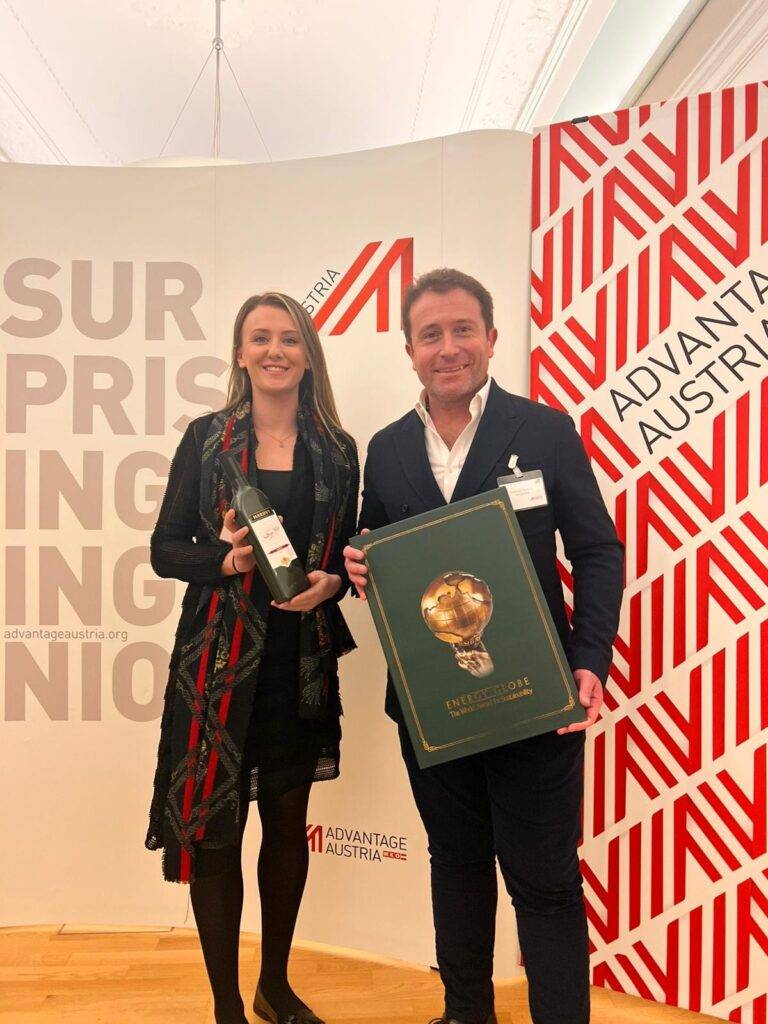
Packamama’s eco-flat wine bottles address both energy and climate, starting with using low energy material feedstock, to more than six times less temperature to blow the bottles, to slashing transportation energy through doubling product on pallets and weighing eight times less. Following in the footsteps of last year’s UK Winners, Islington Council and their initiative to use waste heat from the London Underground to heat homes, Packamama’s CEO Santiago Navarro and Commercial Director Amelia Dales collected the National Award in a ceremony hosted by Advantage Austria on 17th November in London.
The awards jury said: “Our environment is suffering from all the waste being produced worldwide. In this ground-breaking project from this year’s Energy Globe Award National Winner in the United Kingdom, eco-flat bottles were developed that not only save space thanks to their flat shape but are also made from 100% recycled PET to save weight and energy.”
Santiago Navarro, CEO & Co-Founder, commented: “Packamama’s bottle climate tech is shown to halve wine’s emissions by focusing on energy savings throughout the packaging’s lifecycle. It is an honour to be recognised for this, especially with an award founded in Austria, who have a long-standing commitment to green energy. Austria are global leaders in climate action and supporting technologies, mostly focused on energy which contributes at least two-thirds of global emissions. Nearly 80 percent of Austria’s electricity comes from renewable sources, and they have also challenged the EU’s decision on what can be considered environmentally friendly energy sources. Additionally, Austria is also home to close to 11,000 wine producers exporting more than 90 million bottles annually. Finally, Austria’s green energy focus and Packamama’s green wine packaging focus make us a natural fit. We are, therefore, grateful recipients of this award.”
— ENDS —
Additional notes reproduced from Advantage Austria:
ADVANTAGE AUSTRIA London, will present this year’s Energy Globe Awards to winners and honorary projects from Kenya, Rwanda, Guatemala, Swaziland and the United Kingdom at the Award Ceremony on 17 November 2022.
ENERGY GLOBE AWARDS
People all around the world are committed to developing solutions for the most pressing environmental problems of our time – problems like resource scarcity, air and water pollution, erosion, climate change or dependence on fossil fuels. Although these solutions are readily available, they often remain unknown. Energy Globe gives them a voice, makes them visible to a large audience and encourages others to come up with their own innovative solutions.
With more than 180 participating countries, the Energy Globe Award is the world’s most important environmental award. Projects from all over the globe are submitted, ranging from small and simple initiatives to large scale high-end ones. The national winners of the Energy Globe Award are published in cooperation with UNIDO and have one thing in common: all of them have understood that the environment is protected by action not words.
THIS YEAR’S WINNERS ARE
National Energy Globe Award United Kingdom 2022 for the project “Packamama’s eco-flat bottles”
Eco-flat bottles are enabling advancement in the wine industry by slashing carbon footprint and offering unbeatable supply chain efficiencies. These efficiencies are made possible thanks to the bottles’ flat shape to save space and being made entirely from 100% recycled PET to save weight and energy and contribute to circular economies. These improvements mean the bottle itself is 40% more spatially efficient and 87% lighter (just 63g) than a traditional round, glass wine bottle. Being flat, the bottles pack like books and in some instances can fit up to 91% more product on a standard UK pallet. Recyclability is fundamental to the design and the bottle is fully, easily and widely recyclable after use.
“Community Rain Gardens with SuDS“, United Kingdom 2022
Meristem Design Ltd has been delivering community Rain gardens with SuDS across London to help reduce the impact of flooding on communities and add more greenery to streets. Most of the fifty Rain Gardens are on the end of residential roads diverting surface rainwater from the sewer system. Local residents and school children have been involved in planting a variety of grasses, shrubs, and trees to encourage pollinating insects and to withstand the extra-warm summers. The rain gardens also incorporate an underground Sustainable Drainage System (SuDS). The rain gardens combined with the SuDS can absorb 50% more water than grass and help mitigate the impact of flooding in urban areas by allowing vegetation and plants to absorb most of the rainwater. Rain gardens are an effective solution to reduce the impacts whilst engaging with local communities and adding more greenery.
“Rural Mini-Grids Rwanda“, Rwanda
ARC Power’s objective is the provision of affordable, reliable and clean off-grid solar energy for rural communities and businesses in Rwanda. ARC Power’s approach centres on the identification of sites that can support commercially viable operations, whilst generating significant cost savings to customers, alongside supporting sustainable development objectives regionally.
“Environmental Ecology Project (as part of the Turing Scheme)“, Swaziland
Led by Kaya Responsible Travel, and working with ecology experts in Ecuador and Eswatini, this project offers a 15-day international training placement, whereby students can expand their existing knowledge of environmental ecology. Kaya has selected three areas of focus; African Savannah Ecology, Amazon Wildlife and Habitat Conservation, and Permaculture and Sustainable Land Management. The ultimate goal of this project is to increase student engagement in global environmental issues, and offer socio-economically disadvantaged young people the opportunity to travel in a responsible way.
THIS YEAR’S SPECIAL HONORARY PROJECTS ARE
“Water Filtration and Cookstoves“, Guatemala
This first of its kind Gold Standard project in Guatemala is a partnership between Natural Capital Partners and Ecofiltro to distribute efficient stoves and water filters to families. The improved cookstoves reduce use of wood fuel by 60% compared to a traditional three stone fire. This prevents forest degradation and cuts around 100,000 tonnes of CO2 every year. These carbon reductions are independently verified and then sold to corporate clients around the world to offset their emissions, providing the finance needed for the project to grow. By reducing harmful indoor air pollution and providing access to safe water, the project also improves the health of rural families – who have reduced stomach illness and respiratory disease. The reduction in wood fuel used also saves families an average of $3.47/week and over 4 hours/week collecting wood.
“Haller Farmers App (HFA)“, Kenya
The Haller Foundation’s project, HFA equips small-scale farmers in East Africa with affordable, organic & regenerative methods to grow food sustainably. It provides the knowledge & tools to reclaim land deemed ‘unfarmable’. HFA allows farmers to change what & how they farm, subsequently enabling them to withstand climate shocks & continue to earn a livelihood. The adaptive techniques mean they’re no longer hostage to climate change, poor nutrition & depleted soils.
Packamama is the climate tech packaging business designed for a circular economy and offering packaging protecting Mother Earth, that has been spun off from Garçon Wines. Believing in the far-reaching opportunity that packaging offers to be a force for good, Packamama is on a mission to help create a low carbon future in the drinks industry, starting with better wine bottles: multi award-winning, eco-flat bottles that save space, weight and energy to slash emissions. This tackles the wine industry’s carbon footprint hotspot of round, glass bottles. Headquartered in London, UK, Packamama is powered by a production network of industry leaders in the UK, Australia and soon, the US and France. A passionate team provide forward-thinking wine companies and brands with the packaging and production to implement Packamama’s IP-protected portfolio of innovative, climate-friendly bottles into their businesses and across the world.